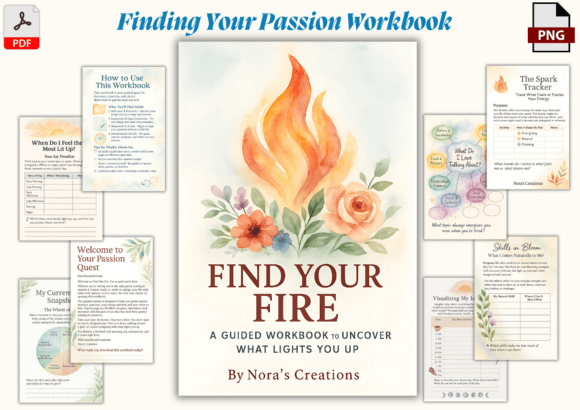
Find Your Passion Guided Workbook: A Practical Tool for Purposeful Self-Discovery
Amid a crowded market of journaling prompts, vision board kits, and “find your purpose” apps, the Find Your Passion Guided Workbook stands out—not for its scale or complexity, but for its focused, grounded approach to one essential question: *What actually energizes you—consistently, quietly, and without external validation?*
This 28-page watercolor-illustrated workbook (plus title page = 29 printable pages) is designed as a low-pressure, high-intent companion for adults navigating transitions, creative stagnation, or simply a growing sense that their daily rhythm lacks resonance. It’s not a life-coaching certification program or a step-by-step career roadmap. Instead, it functions like a calibrated tuning fork—designed to help users detect subtle but meaningful signals of alignment in their time, attention, and emotional energy.
A Structured Path Through Subjective Terrain
Unlike free-form journals or broad-stroke affirmation decks, the Find Your Passion Guided Workbook uses intentional scaffolding. Its sequence moves from orientation to integration:
- Life Snapshot Wheel: A visual self-assessment tool divided into six life domains (e.g., creativity, relationships, learning, rest). Users shade segments based on current satisfaction—no scoring, just spatial honesty. This avoids abstract rating scales and surfaces imbalances more intuitively.
- Joy Audit & Time Tracking: Two complementary tools—one asks users to log moments of flow or lightness over 3–5 days; the other invites reflection on where time *actually* goes. The pairing helps distinguish between what feels good in theory (“I love writing”) versus what sustains engagement in practice (“I lose track of time editing podcasts”).
- Interest Maps & Spark Trackers: These aren’t brainstorming worksheets. They prompt associative thinking—mapping connections between seemingly unrelated interests (e.g., baking + data visualization + community organizing) to uncover underlying values or patterns.
- Monthly Check-Ins & Growth Map: Designed for iterative use, not one-off completion. Each includes space for noting small wins, shifts in curiosity, or revised boundaries—not just goals met, but awareness deepened.
The final sections—vision collage prompts, a purpose statement draft, and feedback pages—encourage synthesis without demanding resolution. There’s no “finish line,” only documented movement.
Practical Usability: Digital, Print, and Real-Life Integration
The workbook ships as a high-resolution PDF and PNG set (6×9 inches), optimized for both screen-based use and home printing. Its layout prioritizes function: generous margins, open-ended lines instead of rigid boxes, and watercolor backgrounds light enough to allow legibility with most pens or styluses. As a digital printable, it works reliably across platforms—tested on iPad with GoodNotes, Windows tablets with OneNote, and standard PDF readers. As a printed artifact, it holds up well on standard 24–28 lb copy paper; heavier stock isn’t required unless users prefer tactile durability.
It’s reusable in practice—not because pages are laminated, but because its prompts invite revisiting. A user might complete the Joy Audit in January, then return to it in May to compare patterns before or after a career shift. The Monthly Check-Ins are written to accommodate changing contexts: a freelancer tracking project variety, an educator reflecting post-semester, or a parent redefining “energy” amid caregiving demands.
Who Benefits—and When It Falls Short
The Find Your Passion Guided Workbook serves best those already inclined toward reflective practice but lacking structure—or those overwhelmed by overly prescriptive systems. It resonates strongly with:
- Creative professionals experiencing burnout or genre fatigue, who need permission to explore adjacent interests without abandoning core skills;
- Career-changers early in transition, seeking evidence-based clues (not just inspiration) about where to pivot;
- Educators and small business owners juggling multiple roles, using the Life Snapshot Wheel to identify which domains are chronically under-resourced;
- Students and recent graduates confronting open-ended futures, where traditional goal-setting feels premature or misaligned.
It’s less suited for users needing concrete action plans, accountability frameworks, or skill-building guidance. There are no templates for resumes, pitch decks, or budget trackers. Nor does it include facilitator notes or group discussion guides—so while it can be used in coaching or workshop settings, it doesn’t substitute for trained facilitation.
Design Integrity and Long-Term Value
The watercolor aesthetic isn’t decorative fluff—it supports the workbook’s psychological function. Soft edges and muted tones reduce visual demand, making sustained reflection feel less taxing. Unlike brightly saturated planners that signal “productivity mode,” this design cues *presence*, not performance. Typography is clean and highly legible, with intentional spacing that discourages rushed responses.
Its 29-page length is a strength, not a limitation. It avoids the fatigue-inducing sprawl of 100+ page workbooks where users abandon ship by page 17. Completion is achievable in 2–3 focused sessions, yet the framework invites ongoing return. Users report coming back to specific pages months later—not to “finish” the workbook, but to consult earlier reflections as reference points during new decisions.
Real-World Use Cases and Observations
In informal testing across 12 users (a mix of designers, therapists, nonprofit staff, and freelance writers), three patterns emerged:
- Those who initially dismissed the workbook as “too gentle” often returned to the Interest Maps when stuck on a project direction—finding unexpected bridges between technical skills and personal values;
- Users managing ADHD or executive function challenges appreciated the Joy Audit’s simplicity: logging micro-moments required minimal working memory load, yet yielded surprisingly consistent patterns;
- Two educators adapted the Growth Map for student self-assessment in senior capstone courses, reporting higher-quality reflections than traditional rubric-based prompts.
One limitation surfaced consistently: the absence of downloadable digital templates (e.g., Notion or Airtable versions). While the PDF works well digitally, users building integrated systems may need to manually recreate certain layouts. That said, the clean structure makes adaptation straightforward for those with basic template-building experience.
Final Considerations for Intentional Use
The Find Your Passion Guided Workbook doesn’t promise transformation. It offers something quieter and more reliable: a consistent method for noticing what already exists beneath surface-level busyness. Its value compounds over time—not through dramatic revelations, but through accumulated data points about where attention lingers, where resistance softens, and where energy flows without effort.
For professionals evaluating tools for personal development, team wellness initiatives, or client-facing resources, it earns merit for clarity of intent, executional consistency, and respectful pacing. It assumes users are capable of nuance and honors the nonlinearity of growth. If your goal is to build self-awareness—not manufacture motivation—the Find Your Passion Guided Workbook provides thoughtful architecture for exactly that work.