🧵 2026 Craft Business Planner: Where Intentional Creativity Meets Practical Business Growth
Running a craft-based business today means balancing two distinct rhythms: the intuitive flow of making—sketching, stitching, glazing, or assembling—and the steady cadence of operations—pricing, inventory, tax prep, and marketing. That tension used to mean juggling spreadsheets, sticky notes, digital apps, and half-filled notebooks. The 🧵 2026 Craft Business Planner emerges not as another productivity gimmick, but as a thoughtful response to how creative entrepreneurs actually work: with hands *and* strategy, heart *and* spreadsheets, inspiration *and* deadlines.
More Than a Planner—A Designed Workflow for Craft Entrepreneurs
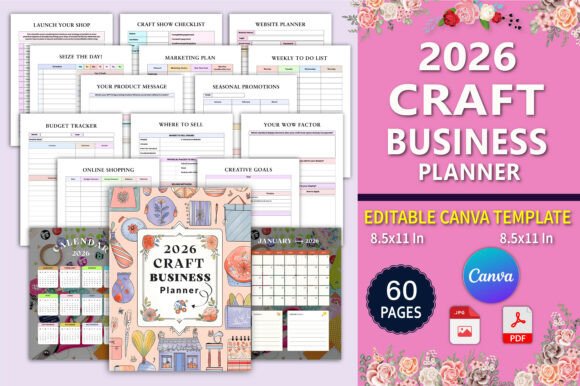
This isn’t a repurposed corporate planner stamped with watercolor accents. Every section of the 🧵 2026 Craft Business Planner reflects real-world friction points: the small-batch maker who sells at three local markets while fulfilling Etsy orders; the ceramicist launching her first wholesale line; the fiber artist expanding into digital patterns and workshops. It’s built on observation—not assumptions. Undated monthly and weekly calendars let you start anytime (no guilt over “missing January”), while annual planning pages help map seasonal peaks—like holiday prep in August or craft fair applications in February—without forcing rigid timelines onto organic creative cycles.
Inventory tracking, for example, goes beyond “how many mugs do I have?” It includes SKU fields, material cost per unit, quantity used per batch, and space to note which colors or sizes consistently sell out. That level of detail matters when scaling production or pricing sustainably—not just covering costs, but honoring your time and materials.
Financial Clarity Without the Overwhelm
Creative professionals often delay financial review—not from neglect, but from mismatched tools. Accounting software feels cold. Generic budget templates ignore variable income streams like commissions, custom orders, or teaching gigs. The 🧵 2026 Craft Business Planner bridges that gap. Its income/expense trackers include dedicated lines for platform fees (Etsy, Square), material restocks, packaging supplies, and even mileage for market hauls. Goal-setting sections tie directly to financial targets: “Save $3,200 for new kiln shelves by October” links to monthly savings benchmarks and expense audits.
Crucially, it avoids prescribing one accounting method. Instead, it supports both cash-basis tracking (ideal for solopreneurs filing Schedule C) and simple accrual-style notes for larger projects—say, a commissioned mural with milestone payments. This flexibility aligns with how IRS guidelines increasingly emphasize record-keeping consistency over rigid methodology for micro-businesses.
Marketing That Fits Creative Realities—Not Algorithms
“Post daily. Go viral. Build an audience.” That advice rarely translates to makers who spend 40 hours a week hand-building, testing glazes, or sewing seams. The 🧵 2026 Craft Business Planner’s marketing planner focuses on *leverage*, not volume. Monthly spreads include space to identify one high-impact action—like photographing three bestsellers with natural light and consistent styling—or drafting three email newsletter snippets tied to upcoming seasons or shows. SMART goal prompts (“Specific, Measurable, Achievable, Relevant, Time-bound”) guide realistic commitments: “Add alt text and product keywords to 12 listing photos by March 15” is more actionable—and trackable—than “improve SEO.”
It also acknowledges hybrid visibility: yes, Instagram matters—but so does showing up at the downtown makers’ market with well-organized receipts and follow-up cards. Customer receipt and order form pages integrate physical and digital workflows, letting you log in-person sales alongside online orders, then cross-reference what resonates across channels.
From Craft Shows to Community: Planning With Purpose
Craft fairs remain vital for many creators—not just for revenue, but for direct feedback, community connection, and tactile brand experience. Yet prepping often devolves into last-minute panic: forgotten signage, under-budgeted display costs, unclear donation records for charitable booths. The 🧵 2026 Craft Business Planner dedicates structured space to this: checklists broken into “30 days before,” “7 days before,” and “day-of” categories; donation logs with space for recipient name, item description, and tax-deductible value; even a “lessons learned” column post-event to refine future participation.
This reflects a broader shift: craft entrepreneurs are becoming more selective about where they invest energy. They’re asking, “Does this show align with my ideal customer? Does it support my long-term goals—or just fill calendar space?” The planner supports that discernment by making evaluation part of the process, not an afterthought.
Branding Beyond the Logo
Your brand isn’t just your color palette or font choice—it’s how customers feel when they hold your handmade notebook, unbox your soy candle, or read your email about sourcing ethical wool. The 🧵 2026 Craft Business Planner’s Website & Branding Kit guides reflection *before* design decisions: What core values do your products embody? (e.g., “slow making,” “local sourcing,” “gender-inclusive sizing”). Which three adjectives should describe every customer touchpoint? Where do your digital assets live—and are backups current? It treats branding as living infrastructure, not a one-time logo refresh.
This resonates with how platforms now prioritize authenticity over polish. Buyers scroll past overly curated feeds but pause for honest stories—like a pottery maker documenting a kiln failure and recovery. The planner’s creative sketch pages encourage that kind of iterative, low-stakes ideation: doodling packaging concepts, mapping customer journey touchpoints, or collaging textures that reflect your aesthetic evolution.
Why Now? Timing, Tools, and Tiredness
The rise of tools like the 🧵 2026 Craft Business Planner mirrors deeper shifts. First, economic uncertainty has made financial intentionality non-negotiable—even for side hustles. Second, digital saturation has increased demand for analog grounding: paper planners offer cognitive benefits—reduced distraction, improved retention—that screens struggle to replicate. Third, creators are rejecting “hustle culture” in favor of sustainable pacing. A planner that honors both sketching time *and* invoicing time validates that balance.
It’s also a practical answer to app fatigue. Juggling Notion for project management, QuickBooks for bookkeeping, Canva for social graphics, and Google Sheets for inventory fragments attention. One cohesive, tactile system reduces cognitive load—especially for those managing multiple roles without administrative support.
Getting Started—Without Pressure
You don’t need to fill every page on January 1st. Start with what’s urgent: use the launch checklist when preparing a new product drop, the inventory tracker before your next supply order, or the goal planner during a quiet Sunday morning. The undated format means you can begin with the section that solves your *current* bottleneck—not a prescribed sequence.
Realistic habit-building matters here too. If weekly planning feels daunting, try biweekly. If sketching feels intimidating, use the creative pages for bullet-pointed ideas or photo references instead. The tool adapts to you—not the other way around.
For craft entrepreneurs navigating complexity without losing their creative spark, the 🧵 2026 Craft Business Planner offers something rare: structure that serves imagination, not suppresses it. It assumes your work is valuable—and gives you the grounded, adaptable framework to protect, scale, and celebrate it—year after thoughtful year.