Human Body Word Search Ebook: Make Anatomy Learning Engaging, Effective, and Accessible
Teaching or learning human anatomy doesn’t have to mean memorizing dry diagrams or flipping through dense textbooks. For educators, homeschooling parents, tutors, and curious learners alike, the Human Body Word Search Ebook offers a refreshingly practical solution—turning foundational biology vocabulary into an interactive, low-pressure, and highly effective learning tool. It’s not just another worksheet; it’s a thoughtfully designed resource that bridges engagement with retention, especially for topics where terminology can feel overwhelming.
Many adults supporting learners—whether in classrooms, home environments, or informal tutoring settings—face real challenges: students disengaged by traditional methods, limited time to prepare differentiated materials, inconsistent vocabulary reinforcement, or difficulty assessing understanding without formal testing. At the same time, goals remain clear: build accurate anatomical literacy, support long-term recall of key terms (like *phalanges*, *trachea*, *esophagus*, or *quadriceps*), and foster confidence in discussing body systems. The Human Body Word Search Ebook directly addresses these needs—not by replacing core instruction, but by strengthening it through repetition, visual scanning, and active recall in a relaxed format.
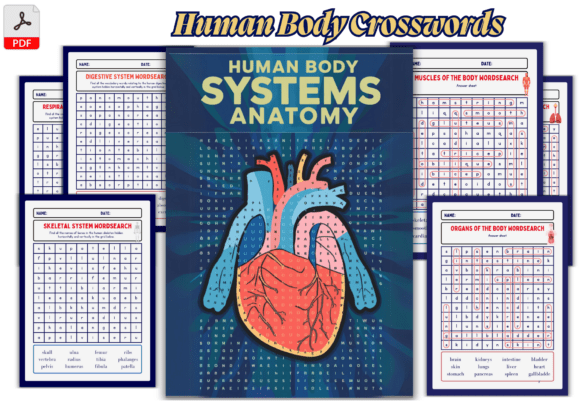
This printable bundle includes five targeted A4-sized word searches—each focused on a major aspect of human anatomy: the Skeletal System, Digestive System, Respiratory System, Organs of the Body, and Muscles of the Body. Every puzzle is built around authentic, curriculum-aligned vocabulary—terms students encounter in middle school science, high school biology, health classes, or introductory anatomy courses. Because each puzzle isolates one system, learners gradually layer knowledge instead of confronting a jumbled list of unrelated terms. That structure supports cognitive load theory: it reduces mental strain while increasing comprehension and retention.
What makes this more than just a set of puzzles? First, every puzzle comes with a ready-to-use answer key—saving educators and parents valuable time on grading or verification. Second, the files are delivered instantly as high-resolution PDF and PNG formats, optimized for both printing (8.5 × 11 inches / A4) and digital use—meaning you can project a puzzle during class discussion, assign it via learning platforms like Google Classroom, or print copies for hands-on station rotations. No waiting. No formatting headaches. Just immediate, classroom-ready utility.
Consider how different users apply the Human Body Word Search Ebook in practice:
- Classroom teachers use the Skeletal System puzzle as a warm-up before dissecting bone models—or as a review activity after completing a unit on joints and cartilage. It sparks conversation (“Why is ‘patella’ listed here but not ‘kneecap’?”), reinforcing scientific terminology alongside everyday language.
- Homeschoolers and tutors integrate the Digestive System puzzle into a week-long unit on nutrition, pairing it with simple experiments (like modeling peristalsis with a tube and marbles) and labeling diagrams. The word search becomes a tactile checkpoint—helping identify gaps before moving forward.
- Parents seeking screen-free enrichment keep printed copies on hand for rainy days or travel. Completed puzzles often lead to spontaneous questions (“Mom, what’s the diaphragm do again?”), turning quiet time into organic, curiosity-driven learning.
- Lifelong learners and adult education facilitators use the Organs of the Body puzzle in wellness workshops—connecting anatomy to daily habits (e.g., “How does the liver process what we eat?”). It’s an inclusive entry point for those returning to science after years away from formal study.
The educational value lies not only in finding words—but in the thinking that happens along the way. Scanning for terms like *alveoli*, *ileum*, or *biceps brachii* requires attention to spelling, syllable patterns, and root words (*-itis*, *-logy*, *endo-*, *epi-*). Over time, this builds morphological awareness—a proven predictor of science vocabulary growth. And because learners self-correct using the included answer keys, they develop metacognitive habits: noticing errors, revisiting definitions, and making connections across systems (e.g., realizing the diaphragm appears in both Respiratory and Muscular puzzles).
For best results, pair the Human Body Word Search Ebook with complementary strategies. Before assigning a puzzle, briefly introduce three to five key terms with visuals or short analogies. After completion, ask learners to choose two terms and write a sentence showing how they work together (“The trachea carries air to the bronchi, which branch into smaller tubes leading to the alveoli.”). You might also encourage color-coding—shading bones in blue, muscles in red, organs in purple—to reinforce system-based categorization visually.
It’s also worth noting what this resource intentionally avoids: flashy animations, forced gamification, or distracting clipart. Its strength is in its simplicity and focus. That makes it especially useful for neurodiverse learners—including those with ADHD or dyslexia—who benefit from clean layouts, predictable structure, and clear visual boundaries. The high-contrast, sans-serif font and generous spacing reduce visual fatigue, while the self-paced nature allows for breaks and repeated attempts without pressure.
If you’ve tried flashcards that get lost, quizzes that feel like tests, or videos that scroll past too quickly—the Human Body Word Search Ebook offers grounded, repeatable, and adaptable support. It doesn’t assume prior expertise. It doesn’t require special software or subscriptions. And it meets learners where they are: sometimes needing quiet focus, sometimes sparking conversation, sometimes serving as a confident first step into complex subject matter.
In short, this isn’t about filling time—it’s about building understanding. Whether you’re guiding a 12-year-old through their first deep dive into how the body works, helping a high school student prepare for a biology exam, or relearning anatomy as part of a personal health journey, the Human Body Word Search Ebook delivers consistent, low-friction reinforcement. It turns vocabulary from abstract labels into familiar, usable tools—and that’s where real learning takes hold.