Why Your Safety Program Needs a Reliable Lockout Tagout LOTO Logbook
Every time maintenance begins on industrial equipment, a critical decision is made—not about tools or timelines, but about accountability. That moment hinges on documentation: who locked out what, when, and how. Without clear, consistent records, even the most rigorous lockout tagout (LOTO) procedures can unravel under audit scrutiny—or worse, fail to protect workers during an unexpected startup.
This is where the Lockout Tagout LOTO Logbook steps in—not as a bureaucratic afterthought, but as the operational backbone of your energy control program. It’s more than lined pages in a binder. It’s a structured, field-tested system for capturing real-time safety actions with precision and traceability.
What Makes This Lockout Tagout LOTO Logbook Different?
Not all logbooks are built for compliance—and fewer still are engineered for daily use in high-stakes environments. The Lockout Tagout LOTO Logbook stands out because it anticipates how safety teams actually work:
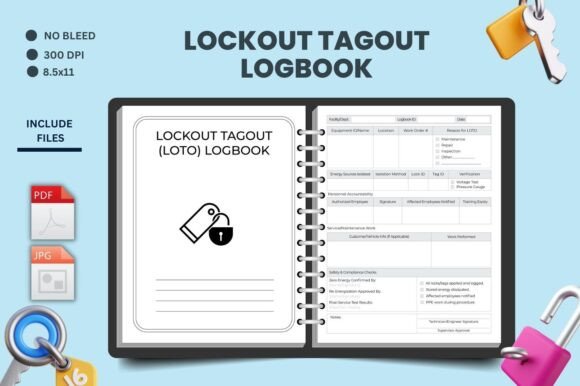
- 120-page interior—enough space for months of documented procedures without constant reordering, yet flexible enough to scale up or down based on facility size or frequency of servicing;
- 8.5″ x 11″ standard size—fits seamlessly into existing filing systems, wall-mounted safety stations, or portable clipboards;
- No bleed, 300 dpi resolution—ensures crisp text and scannable entries whether printed on office printers or commercial presses;
- Ready-to-upload PDF files—tested and verified for Amazon KDP, meaning no formatting surprises, no layout shifts, and zero setup delays;
- Fully customizable—add your company logo, modify headers, insert internal policy notes, or adjust section order to match your site-specific LOTO plan.
Unlike generic notebooks or hastily assembled Excel sheets, this Lockout Tagout LOTO Logbook includes dedicated sections proven to reduce human error: equipment identification fields, lock and tag ID tracking, authorized employee sign-offs, verification timestamps, and status updates (e.g., “in progress,” “verified,” “restored”). Each page guides users through the OSHA-required elements—not as abstract concepts, but as intuitive, fill-in-the-blank prompts.
How It Fits Into Real-World Safety Workflows
Picture a shift change at a food processing plant. A technician finishes isolating a conveyor belt, applies three padlocks, and tags each energy source. Before walking away, they open the Lockout Tagout LOTO Logbook, locate the entry for Line B – Conveyor 4A, and record: equipment ID, isolation points (main power disconnect, pneumatic line valve, hydraulic pressure release), lock numbers (LKT-772, LKT-773, LKT-774), tag IDs, their name and signature, and the exact time.
That entry doesn’t just satisfy a checkbox—it creates a living chain of custody. When the next shift arrives, they don’t rely on memory or verbal handoff. They flip to the same page, verify the locks are still in place, and see exactly who approved the isolation and when. If a supervisor audits the log later, they’ll find consistent formatting, legible handwriting (or typed inserts), and chronological continuity—key markers OSHA inspectors look for during walkthroughs.
In manufacturing, utilities, HVAC, and facilities management, this level of structure prevents common breakdowns: overlapping lockouts, forgotten isolation points, unverified releases, or unauthorized removals. The Lockout Tagout LOTO Logbook doesn’t replace training—but it does reinforce it, turning procedural knowledge into repeatable, auditable action.
Why Resolution, Format, and Print Readiness Matter More Than You Think
A logbook isn’t useful if it blurs when photocopied, smudges when handled with oily gloves, or fails to upload cleanly to KDP. That’s why high-resolution PDFs and JPGs at 300 dpi aren’t just “nice-to-haves”—they’re functional necessities.
Consider this: a maintenance team prints 20 copies for different departments. Low-res files produce fuzzy text, especially in small-font fields like lock ID numbers or timestamps. Illegible entries invite rework, delay approvals, and raise red flags during third-party audits. With the Lockout Tagout LOTO Logbook, every character remains sharp—even when scaled to fit a laminated job aid or converted to a digital tablet form.
The 8.5″ x 11″ trim size also reflects practical wisdom. It’s large enough to accommodate detailed sketches or multi-step checklists, yet compact enough to store in a toolbox or hang beside a control panel. And because it’s designed with “no bleed,” margins stay intact on any printer—no risk of clipped headers or cutoff signatures.
Customization That Scales With Your Needs
One-size-fits-all rarely fits safety. A regional distribution center may need space for fleet vehicle LOTO. A pharmaceutical lab might require additional fields for cleanroom-specific verification steps. A municipal water treatment facility could benefit from integration with CMMS ticket numbers.
The Lockout Tagout LOTO Logbook supports those variations—not through vague “editable templates,” but through true customizability. You can:
- Add your organization’s safety header and revision date;
- Insert site-specific definitions (e.g., “Group LOTO Coordinator” or “Authorized Electrician Level II”);
- Embed QR codes linking to video SOPs or emergency response protocols;
- Adjust page count to align with annual inspection cycles or departmental volume;
- Include bilingual fields for multilingual teams—without sacrificing readability.
This flexibility means the logbook grows with your program—not the other way around.
Compliance Confidence, Built In
OSHA 29 CFR 1910.147 doesn’t mandate a specific logbook format—but it *does* require employers to document LOTO procedures, training, inspections, and deviations. The Lockout Tagout LOTO Logbook maps directly to those expectations:
- Procedure documentation: Dedicated equipment and isolation point fields support written procedures required under 1910.147(c)(4)(ii);
- Employee training records: Signature lines and role identifiers help verify authorized personnel per 1910.147(c)(7)(i);
- Periodic inspections: Date-stamped entries create natural audit trails for the mandatory annual review (1910.147(c)(6)(i)(A));
- Tag and lock accountability: Unique ID tracking satisfies requirements for identifying devices used (1910.147(c)(5)(ii)).
It’s not about passing a single audit. It’s about building evidence over time—so when questions arise, your records speak clearly, consistently, and confidently.
Making the Right Choice for Your Team
When evaluating a Lockout Tagout LOTO Logbook, ask these practical questions:
- Does it eliminate guesswork—so new hires can complete entries correctly on day one?
- Can supervisors scan a week’s worth of logs in under two minutes and spot inconsistencies?
- Will it hold up physically—through grease, moisture, and repeated handling—without compromising legibility?
- Is it truly plug-and-play, or does it demand hours of design tweaks before first use?
The answer, across industries and team sizes, increasingly points to a purpose-built solution. Not a repurposed notebook. Not a spreadsheet that breaks when shared. A Lockout Tagout LOTO Logbook designed by people who’ve stood beside machines mid-service—knowing that clarity, consistency, and compliance begin with the very first pen stroke.