2025-2026 Reading Journal
Reading isn’t just consumption—it’s a deliberate practice. Whether you’re refining your expertise, building content pipelines, designing curricula, launching a book-related business, or simply protecting mental space in a high-output work environment, how you track, reflect on, and act on what you read directly affects retention, insight generation, and long-term growth. The 2025-2026 Reading Journal is built for that reality: not as a static log, but as an adaptable workflow tool designed to integrate seamlessly into professional routines, creative cycles, and personal development systems.
How It Fits Into Real Workflows
This journal doesn’t sit on a shelf—it moves with you. Its structure supports three distinct phases of engagement: before reading (planning and intention-setting), during reading (tracking progress, capturing notes, managing series or multi-book projects), and after reading (reviewing, connecting ideas, deciding next steps). For example:
- A freelance writer uses the “Book to Read” and “Book Lists To Read” pages to batch-research topics before pitching articles—then shifts to “Currently Reading” and “Notes” pages while drafting, anchoring arguments in specific passages.
- An educator maps curriculum-aligned titles across the “Yearly Reading Goals” and “Home Reading Tracker,” then pulls quotes from the “Favorite Quotes” section into lesson handouts or staff development slides.
- A small business owner tracks industry books alongside competitor releases using “Book Release” and “Library Book Tracker,” cross-referencing insights against quarterly strategy reviews in the “Weekly Planner” and “Books My Month” pages.
It’s not about logging more—it’s about logging with purpose. Each page serves a functional role, and none require rewriting or reformatting. That consistency reduces friction when transitioning between roles: teacher to parent, creator to client-facing strategist, learner to mentor.
Compatibility With Your Existing Tools
The 2025-2026 Reading Journal is intentionally platform-agnostic. You don’t need to migrate data or learn new software. Its editable Canva link works alongside tools you already use:
- Notion or Obsidian users export key summaries or ratings from “Book Review” or “Series Book Review” pages as lightweight reference blocks—no manual retyping.
- Google Calendar or Outlook users align “Monthly Planner” pages (January–December for both 2025 and 2026) with deadlines, launch windows, or learning sprints—then use “Home Reading Diary” to record actual time spent, not just planned time.
- Canva designers, marketers, and content creators drop PNG or JPG exports directly into social posts, newsletters, or portfolio case studies—no resizing or quality loss, thanks to 300 DPI and 8.5×11 inch no-bleed formatting.
Because it’s editable in Canva—free account required—you retain full control over color schemes, fonts, and layout spacing without design debt. No templates lock you in. You adjust headers, reorder sections, or duplicate pages like “Currently Reading” for parallel projects (e.g., one for professional development, another for fiction).
Practical Implementation Tips
Start where your current process has gaps—not where the journal looks prettiest. Here’s how experienced users deploy it efficiently:
- Prep once, use all year: Before January 2025, fill in “Yearly Reading Goals” and “Book Wishlist.” Then use “Books I Have” and “My Library” pages to audit physical/digital inventory—this prevents redundant purchases and surfaces unread gems.
- Batch your tracking: Instead of logging each book individually, set aside 15 minutes weekly to update “Finished Books,” “Did Not Finish,” and “Library Book Tracker” together. This surfaces patterns—like recurring drop-off points or genre imbalances.
- Leverage dual-year structure: Use the 2025 and 2026 calendars side-by-side to map longer arcs—e.g., a 12-month deep-dive into behavioral economics, with quarterly milestones tracked in “Books My Month” and reflections captured in “Notes.”
- Use “Series Fracher” proactively: If you follow multi-book series, populate this early—even before starting Book 1. It helps you visualize pacing, avoid spoilers, and plan reading windows around release dates logged in “Book Release.”
Quality control happens in usage, not setup. Because the journal includes 58 unique, pre-sized Canva pages (all 8.5×11, no bleed, 300 DPI), there’s zero guesswork about print readiness or digital legibility. PDF, JPEG, and PNG files are optimized for sharing, presenting, or archiving—no compression artifacts, no font substitution issues.
Long-Term Use and Consistency
Most reading trackers fail not from poor design, but from misaligned expectations. They assume daily discipline—but professionals rarely have predictable, uninterrupted time. The 2025-2026 Reading Journal accounts for that:
- “Home Reading Tracker” uses simple checkmarks and time estimates—not rigid hourly logs—so you can record progress even during fragmented moments (e.g., 12 minutes on the train, 7 minutes waiting for a call).
- “Did Not Finished” isn’t a failure log—it’s a decision log. You note why (e.g., “relevance shifted post-client brief,” “author’s framework contradicted latest research”), turning abandonment into actionable insight.
- “Book To Buy” and “Book to Read” are kept separate, preventing impulse purchases that don’t serve current goals—and reducing cognitive load when scanning options.
Consistency builds from utility, not obligation. When a page saves time or clarifies next steps—like “Series Book Review” helping you decide whether to continue a trilogy based on character arc resolution or thematic payoff—you’ll reach for it without prompting.
What You Actually Receive
You get more than a template. You get production-ready assets, structured for immediate deployment:
- Editable Canva link: Fully customizable—change colors, swap icons, add your logo, rearrange pages. No design skills needed.
- High-quality PDF files: Print-ready, searchable, bookmarked by section for quick navigation.
- JPEG and PNG exports: Crisp visuals for social media, email headers, or client decks—no pixelation, no cropping surprises.
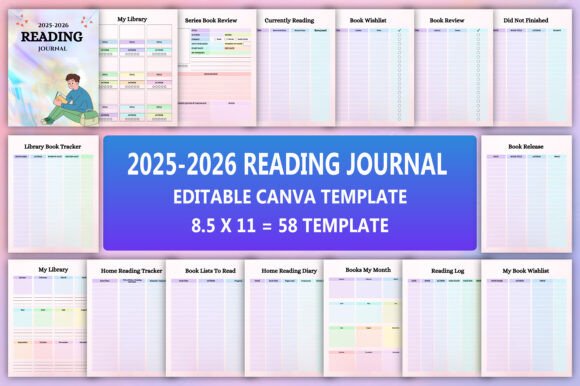
- 58 distinct pages, including specialized tools like “Library Book Tracker,” “Series Fracher,” and dual-year planners—each solving a real problem, not filling space.
No subscriptions. No watermarks. No upsells. Just a focused, well-structured system—designed for people who read to act, not just accumulate.
Final Thought: It’s About Direction, Not Volume
Your reading volume matters less than its alignment with your goals—whether that’s launching a podcast, improving team communication, writing a novel, or staying ahead in a fast-moving field. The 2025-2026 Reading Journal exists to make that alignment visible, trackable, and adjustable. It doesn’t ask you to read more. It asks you to read with clearer intent—and gives you the infrastructure to follow through, month after month, without reinventing the system.
Thank you for visiting my shop. You’ll receive instant access to all files—including the editable Canva link—immediately after purchase. Start planning, tracking, and reflecting with confidence, knowing every page supports real work, not just good intentions.