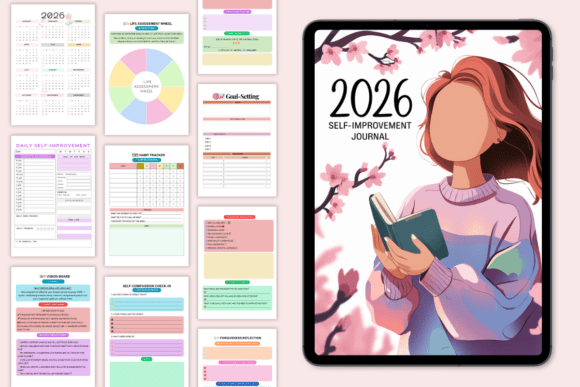
2026 Self-Improvement Journal
If you’ve ever stared at a blank notebook wondering where to even begin—or opened a journal only to abandon it by February—you’re not alone. The 2026 Self-Improvement Journal isn’t another “just write more” prompt book. It’s built for real life: the messy mornings, the back-to-work Mondays, the quiet moments after a tough conversation, and the small wins that rarely make it into your calendar.
When Life Feels Like Too Many Tabs Open
Imagine this: You’re juggling a new role at work, supporting aging parents, trying to rebuild a fitness habit, and still hoping to read more than three books this year. Your to-do list is long, but your energy feels thin—and motivation? It comes in unpredictable bursts. That’s exactly when the 2026 Self-Improvement Journal shifts from “nice idea” to essential tool.
The Mind Dump Brain Cleanse Pages give you permission to offload mental clutter—no editing, no judgment. One user, a 34-year-old project manager, told us she used these pages during her commute instead of scrolling: “I’d write down everything swirling—deadlines, worries about my kid’s school transition, even grocery lists. By the time I got to the office, my head felt lighter, like I’d closed five unnecessary browser tabs.”
It’s also ideal for people recovering from burnout or navigating major transitions—like returning to work after parental leave, launching a side hustle, or adjusting to remote work full-time. The journal doesn’t ask you to “be productive.” It asks you to notice, name, and reclaim space—one page at a time.
For the Goal-Setter Who Keeps Getting Derailed
We’ve all set goals with enthusiasm—only to lose steam when reality hits. The Goal-Setting Worksheets in the 2026 Self-Improvement Journal help bridge that gap between intention and action—not by demanding perfection, but by making progress visible.
Take Maya, a 28-year-old graphic designer aiming to launch her freelance business. She didn’t just write “Get clients.” She broke it into steps: “Research pricing models → Revise portfolio → Reach out to 3 past colleagues → Follow up on referrals.” Each week, she checked off what landed—and reflected on *why* certain actions worked (or didn’t). “The reflection prompts changed everything,” she said. “Instead of thinking ‘I failed,’ I asked, ‘What did this teach me about how I actually get referrals?’”
This kind of grounded goal work resonates especially with entrepreneurs, creatives, and career-changers—people whose success depends less on rigid timelines and more on iterative learning.
When You’re Measuring Everything Except What Matters to You
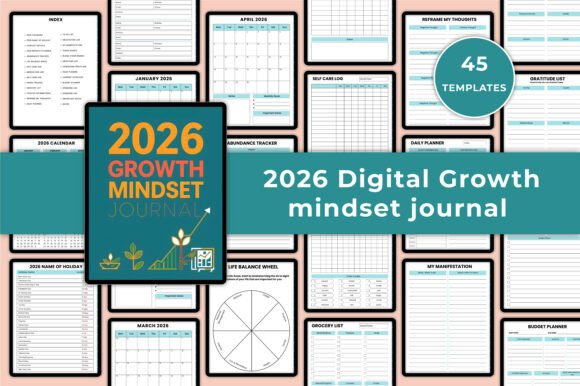
Most planners track meetings, deadlines, and habits—but few help you assess whether your life *feels* aligned. That’s where the Life Assessment Wheel stands out. It invites you to rate satisfaction across six core areas: health, relationships, career, finances, personal growth, and fun—not as scores to optimize, but as signals to listen to.
A 47-year-old teacher used hers after her divorce. “I scored high in ‘career’ and ‘relationships’—but ‘fun’ was a solid zero. I hadn’t realized how much I’d stopped doing things just because they brought me joy. That wheel didn’t shame me. It named something I’d been ignoring.”
This isn’t therapy—but it *is* self-awareness scaffolding. It helps therapists recommend tangible tools to clients, coaches structure check-ins, HR teams support employee well-being initiatives, and even college advisors guide students through identity-shifting years.
For the Overthinker, the Under-Sleeper, and the Quietly Stressed
If your brain races at 10 p.m., if gratitude lists feel forced, or if “self-care” sounds like another item on your checklist—the Daily Reflection Pages offer something gentler. They include mood tracking (with simple emoji-style options), one-line gratitude (“My coffee was hot”), a lesson learned (“Saying ‘not now’ isn’t rude—it’s boundary-setting”), and a tiny win (“I walked without headphones and noticed three birds”).
No grand declarations required. Just noticing. And that noticing builds neural pathways for resilience over time. Teachers use these pages before parent-teacher conferences. Nurses jot them down between shifts. College students keep theirs beside their laptop during finals week—not to fix anything, but to anchor themselves in the present.
What to Keep in Mind Before You Begin
The 2026 Self-Improvement Journal works best when treated as a companion—not a test. You don’t need to fill every page. You don’t have to start on January 1st. Many users begin mid-month, after a vacation, or even in March, following a meaningful conversation or health update.
It’s also intentionally analog. There’s no app sync, no notifications, no data export. That’s a strength for focus—but a limitation if you rely heavily on digital reminders or shared accountability systems. Some users pair it with a simple habit-tracking app (like Loop Habit Tracker) for consistency, while keeping reflections and vision work offline.
And while the journal includes Positive Affirmation Logs, it doesn’t push toxic positivity. Prompts invite honesty first: “What do I need to hear right now?” or “What would kindness sound like today?” That nuance matters—especially for people healing from trauma, managing anxiety, or rebuilding self-trust.
Who Gets the Most Out of It—And Why
- Remote workers & freelancers: The Monthly Calendar Overview helps visualize capacity—not just tasks—so they can protect focus time and avoid invisible overtime.
- New managers: Daily reflection + habit tracking supports emotional regulation and leadership presence—especially when giving feedback or navigating team conflict.
- Parents of young kids: The Habit Tracker Logs let them celebrate micro-wins (“Made lunch without yelling”) and adjust expectations weekly—not just quarterly.
- Students & recent grads: The Books, Podcasts Resource Tracker turns passive consumption into active learning—linking insights back to personal values and next-step experiments.
- People in recovery or life transitions: The Life Assessment Wheel and Mind Dump Pages provide nonclinical, low-pressure ways to monitor internal shifts over time.
At its core, the 2026 Self-Improvement Journal meets people where they are—not where productivity culture says they should be. It doesn’t assume you want to “optimize” your life. It assumes you want to understand it better, move through it with more intention, and recognize your own growth—even when it’s quiet, slow, or sideways.
That’s why so many keep coming back—not because every page is filled, but because the act of opening it feels like returning home to themselves.