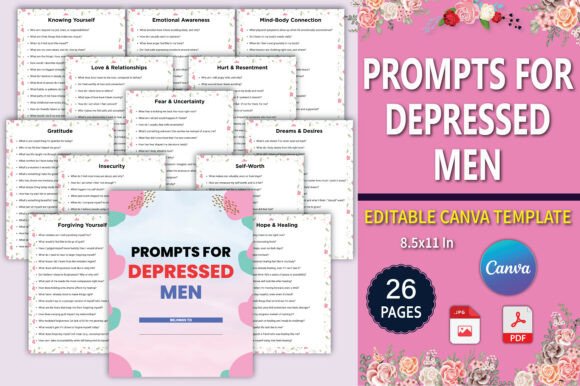
🖤 Prompts for Depressed Men: A Thoughtful, Grounded Approach to Emotional Healing
Depression doesn’t announce itself with fanfare—it often shows up quietly: in canceled plans, restless nights, a growing sense of detachment, or the weight of unspoken emotions. For many men, asking for help feels complicated. Cultural expectations, limited emotional vocabulary, or past experiences where vulnerability was met with dismissal can make traditional support feel inaccessible. That’s why 🖤 Prompts for Depressed Men – 400 Reflective Journal Prompts for Healing, Strength & Mental Wellness stands out—not as a quick fix, but as a carefully designed companion for men ready to reflect, reconnect, and reclaim agency over their inner lives.
What It Is (and What It Isn’t)
This isn’t a clinical workbook disguised as self-help. It’s a printable journal built on therapeutic principles—grounded in acceptance, somatic awareness, narrative therapy, and gender-informed mental health research. The 400 prompts are organized across 25 sections—from “Emotional Awareness” and “Loneliness” to “Rest,” “Self-Worth,” and “Letting Go”—each crafted to meet men where they are: not demanding confession, but inviting honest observation.
It’s also not a replacement for professional care. If you’re experiencing persistent hopelessness, changes in appetite or sleep, or thoughts of harm, please reach out to a licensed therapist or crisis service. This journal works best alongside support—not instead of it.
Mistake #1: Treating It Like a Daily To-Do List
Some users download the PDF, open it on Monday, and try to complete 10 prompts before breakfast—then abandon it by Wednesday. That pressure defeats the purpose. These prompts aren’t assignments; they’re invitations. One thoughtful response to “What does safety feel like in your body right now?” can be more revealing than rushing through ten surface-level questions.
Better approach: Start with just 5–10 minutes, 2–3 times per week. Keep a pen and notebook nearby—not your laptop. Handwriting slows the mind, strengthens neural pathways tied to reflection, and creates psychological distance from digital distractions.
Mistake #2: Expecting Immediate Clarity or “Breakthroughs”
Healing isn’t linear—and journaling isn’t about solving everything in one sitting. You might write, “I don’t know how I feel,” three days in a row. That’s valid. Repetition, ambiguity, and even resistance (“This feels pointless”) are part of the process. The value accumulates in subtle shifts: noticing patterns, recognizing triggers, or catching yourself mid-criticism and pausing.
Better approach: Re-read past entries every two weeks—not to judge progress, but to notice what’s changed in tone, language, or attention. Did “anger” used to show up as blame? Does it now include curiosity about what it’s protecting?
Mistake #3: Overlooking Format Fit
The journal is intentionally printable and offline—no app logins, no notifications, no data tracking. That’s a strength for privacy and focus. But if you rely heavily on voice-to-text tools due to physical fatigue or executive dysfunction, the static PDF format may create friction.
Better approach: Before purchasing, check if your device supports PDF annotation (e.g., Adobe Acrobat Reader or GoodNotes). You can type directly into the document, highlight lines, or add audio notes via linked apps—without compromising the journal’s quiet, judgment-free intent.
Mistake #4: Skipping the Context Behind the Prompts
Not all prompts land the same way. “What would your younger self need to hear right now?” may spark deep resonance—or feel emotionally overwhelming if you haven’t yet built trust in your own voice. Jumping into high-vulnerability sections (like “Grief” or “Trauma”) without first grounding in gentler ones (e.g., “Small Joys,” “Body Signals,” or “What Feels Manageable Today?”) can backfire.
Better approach: Use the section titles as a compass—not a checklist. Flip to “Confidence” only after spending time in “Identity” or “Rest.” Let your intuition guide you. There’s no wrong order—only what serves your nervous system today.
What to Check Before You Begin
- Your current capacity: Are you managing basic needs—sleep, nutrition, movement? Journaling helps deepen awareness, but it won’t compensate for chronic exhaustion or untreated medical conditions. Pair this tool with practical care.
- Your goals: Do you want space to process burnout from work? Navigate grief after loss? Understand recurring anger? The journal supports all of these—but clarity on your intention helps you choose relevant sections and measure meaningful change.
- Your support system: Even private journaling benefits from gentle accountability. Consider sharing one insight (not the whole entry) with a trusted friend, therapist, or support group—or join a low-pressure online community where men share reflections without analysis.
Why This Works Differently
Most mental wellness journals default to universal language—“How are you feeling?”—which can feel vague or alienating for men socialized to suppress or intellectualize emotion. 🖤 Prompts for Depressed Men uses precise, embodied phrasing: “Where do you hold tension when you think about asking for help?” or “What’s one thing your body asked for yesterday that you ignored?”
It also avoids toxic positivity. You won’t find prompts like “What are you grateful for?” without context. Instead, you’ll see: “What felt tolerable today—and what made it so?” That small shift honors complexity instead of demanding forced optimism.
And because it’s designed for real life—not ideal conditions—it includes prompts for low-energy days (“What does ‘enough’ look like right now?”), identity transitions (“How has fatherhood / career change / aging reshaped your definition of strength?”), and even re-entry after setbacks (“What’s one boundary you’d like to gently reinforce?”).
A Final Note on Consistency
You don’t need to journal every day. You don’t need perfect handwriting or profound insights. What matters is showing up—kindly, honestly, and without performance. Depression narrows perspective; this journal gently widens it, one question at a time. Whether you’re a freelancer navigating isolation, a new parent recalibrating identity, or a man in his 40s re-evaluating long-held beliefs—your reflection matters. Not because it fixes everything, but because it affirms: You’re still here. You’re still listening. That’s where healing begins.